Why can't you touch the moai?
The rope lines at the moai sites are not decoration. Chilean law, fragile volcanic tuff and a living ancestral burial ground all sit behind the no-touching rule.
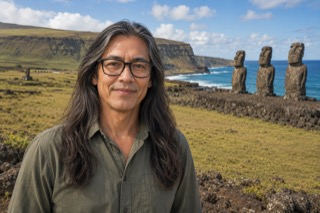 By Pedro Pakarati, Rapa Nui tour guide and archaeological specialist
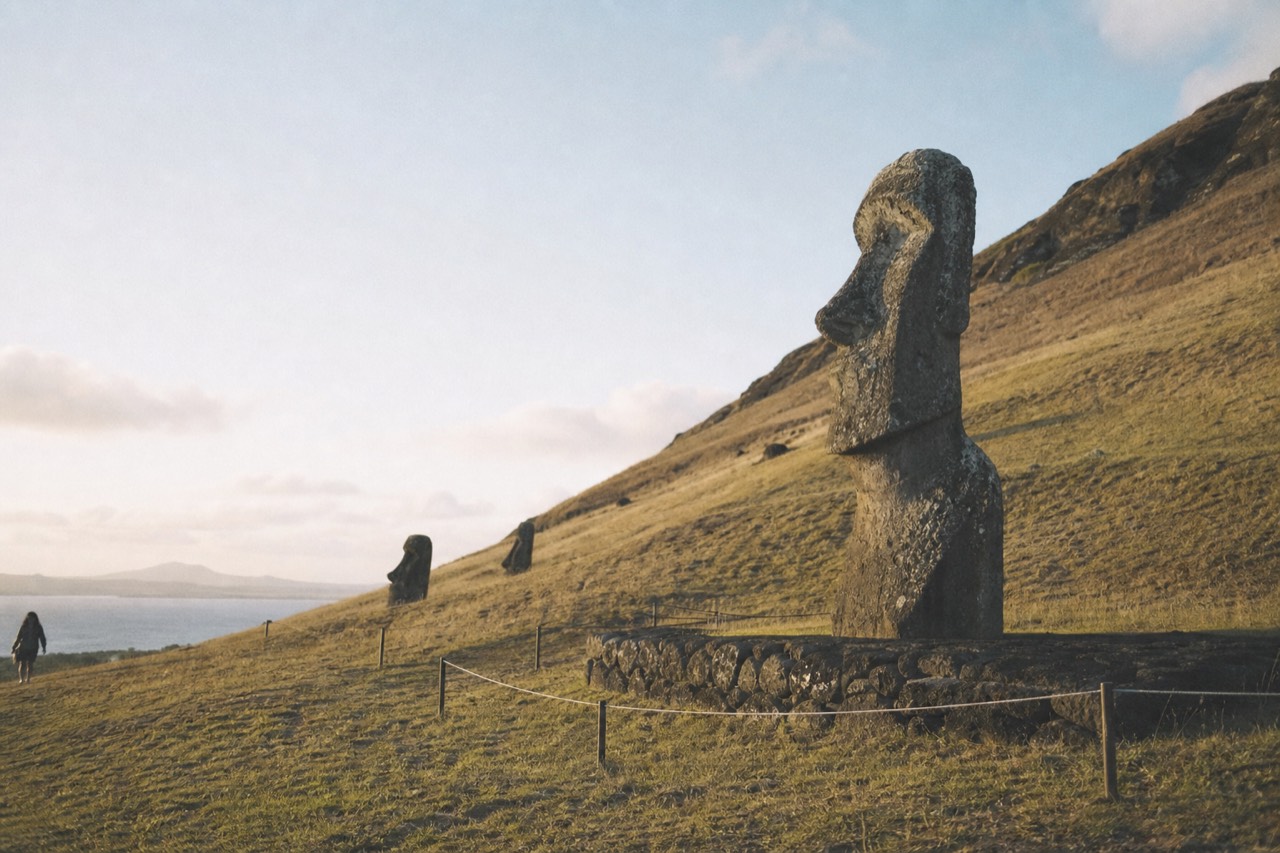
At Ahu Tongariki the rope sits well back from the platform, at a distance that feels almost excessive until somebody explains it. Fifteen statues, several metres of open ground, and a line nobody crosses. Guides do not phrase it as a request. They state it once, at the start, then stop mentioning it, because visitors here almost never test it.
That consistency exists because the reasons stack. This is not a museum keeping fingerprints off a display. It is a legal prohibition with real financial teeth, layered on a measured conservation problem, layered on the fact that the ahu underneath the statues are burial platforms belonging to people who still live here.
What is the actual rule at the moai sites?
You may not touch, lean on, climb, or closely approach a moai or its ahu. Access to park sites requires a Ma'u Henua-accredited local guide, movement is restricted to marked paths and roped corridors, and drones need a permit. Rano Raraku and Orongo each admit you once per park ticket, which is valid for 10 consecutive days.
The rope lines are the visible half. The other half is that you are not there unaccompanied. Rapa Nui National Park is administered by the Ma'u Henua community, and entry is conditional on going in with an accredited guide, so the person explaining the statue is also the person responsible for what happens near it.
| The rule | Where it applies | What it means in practice |
|---|---|---|
| No touching, leaning, climbing or close approach | Every moai and every ahu | Stay behind ropes and off platform stones, tripod legs included |
| Accredited local guide required | All park sites | No independent site visits; Hanga Roa town, the Tahai area and Anakena beach are the practical exceptions |
| Marked paths only | Quarry slopes, platforms, ceremonial ground | The ground itself is archaeology, not just the statues |
| Single entry per ticket | Rano Raraku and Orongo | One visit each, so a rushed first pass cannot be redone |
| Drone permit required | Island-wide | Flying without one is a separate offence |
| Park ticket | 100 USD foreign adult, 40 USD child, 40,000 CLP Chilean adult | Valid 10 consecutive days, bought officially or on arrival, never included in a tour price |
The ticket and access rules are published by the official park ticketing service, and the wider protected-area framework sits with the national forestry service's park page. Neither of them buries the no-contact rule in small print, because it is the first thing both organisations want a visitor to absorb.
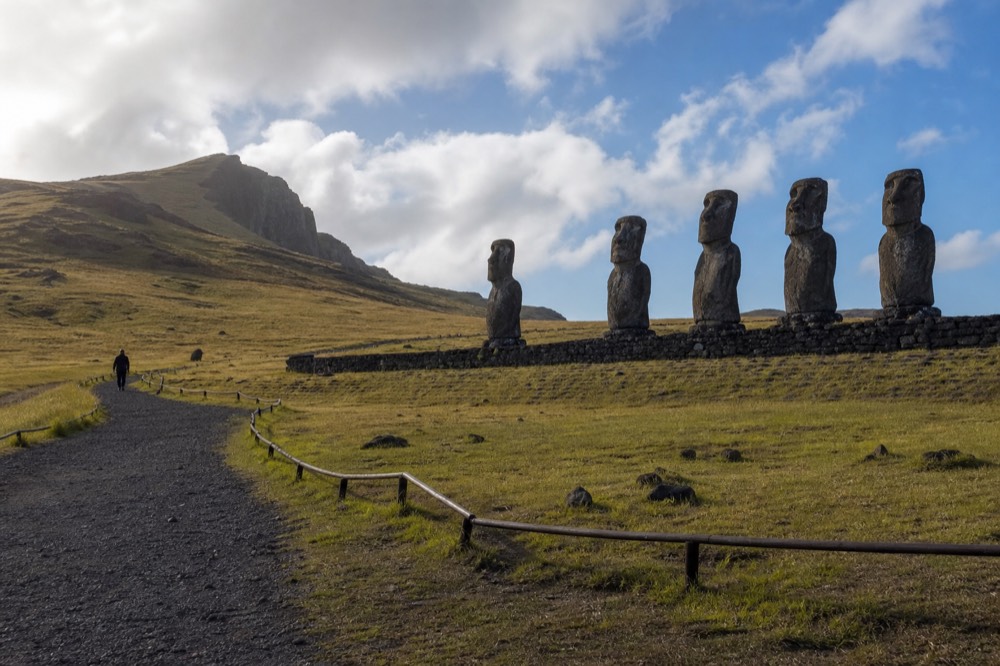
Is touching a moai illegal, or just discouraged?
Illegal. The moai are protected under Chile's Law 17.288 on National Monuments, and penalties for damaging or interfering with them run from 5 to 100 UTM depending on severity. UTM is the Unidad Tributaria Mensual, an inflation-indexed Chilean unit, so the fine tracks the cost of living rather than sitting at a fixed number.
The range is the point. Five UTM is the low end for a minor infringement, 100 UTM is what serious damage attracts, and the scale between them lets authorities treat a hand on a statue differently from a chunk broken off one. There is no tourist exemption and no ignorance defence: everyone entering a park site does so alongside an accredited guide who states the rule.
The legal layer is also the newest of the three reasons, and in a sense the least important one to the community. The Rapa Nui view is that these are aringa ora ata tepuna, the living faces of the ancestors, standing on platforms that served as tombs. Touching one is not vandalism of a sculpture. It is handling a relative's grave marker, on the grave, in front of their descendants.
What does a human hand actually do to volcanic tuff?
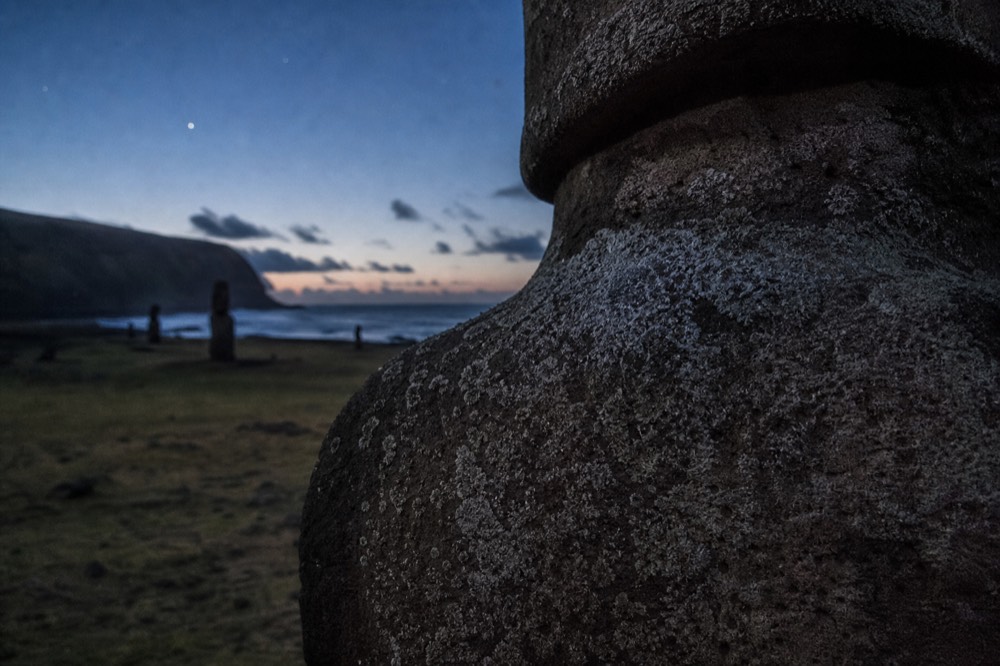
Moai are carved from compressed volcanic ash, a stone soft enough to shape with hand-held basalt tools and therefore soft enough to abrade under repeated contact. Skin oils, grit and pressure work on the surface, and unlike granite the tuff does not shrug it off. Damage from contact is described in the park's own guidance as irreversible.
The material choice that made the moai possible is the same one that makes them vulnerable. Sculptors could cut a five-metre figure out of bedrock with stone chisels because tuff yields. Five centuries of wind and salt have already worked on that surface, and many statues have lost most of their carved detail to weather alone.
| What the rule protects against | The mechanism | What the evidence shows |
|---|---|---|
| Hands on the stone | Abrasion plus skin oils on a porous surface | Contact damage on tuff is irreversible, not cosmetic |
| Climbing and leaning | Point loading on statues already weathered and often previously broken | Around 50 stand upright island-wide, every one re-erected in modern times |
| Walking off marked paths | The ground holds buried torsos, transport roads and platform debris | Most quarry "heads" are full bodies buried by sediment |
| Fire and heat | Steam spalling, soot bonding into the pores, micro-fracturing | The 2022 fire produced effects up to 10 cm below the surface |
| Lichen and biological growth | Colonisation of a porous, damp surface | Lichen control is part of the current treatment sequence |
| Drones without a permit | Downwash, crash risk, disturbance at ceremonial sites | Permit-only, enforced separately from the contact rules |
There is a scale problem behind this. Even a small per-visitor effect, multiplied across a site that saw around 150,000 visitors a year at the 2019 peak, becomes damage measured in lost surface. The full moai explainer covers how those surfaces were made.
What did the 2022 fire prove about how fragile they are?
A wildfire crossed the Rano Raraku quarry in October 2022 and charred or cracked statues across the slope, with preliminary counts putting the affected number near 80 and around 22 showing significant damage. Later analysis found heat effects reaching 10 centimetres below the stone surface. Some of that damage is described as irreparable.
That subsurface figure reframes everything. A statue can look merely blackened and still have micro-fractures running a hand's width into it, the kind of harm that does not announce itself and does not stop progressing once the visible mess is cleaned up.
The response has been careful rather than fast. UNESCO's Heritage Emergency Fund backed an assessment and a risk management plan in 2023, at around 97,000 dollars. Physical conservation began in May 2025, run by the Ma'u Henua community with restorers from the University of Florence, on five of the worst-affected statues. That work is described in the reporting on the island's own restorers.
Access to the quarry has been restored and the scarring is visible from the path, which makes a direct argument. A community spending years and international funding to recover five statues from one bad afternoon will not be relaxed about a thousand pairs of hands.
Who enforces it, and how does that feel on the ground?
Ma'u Henua rangers and accredited guides, through ropes, signage and direct instruction rather than through confrontation. Guides state the rule at the start of a site visit and are accountable for their group. In practice, enforcement on Rapa Nui is quiet, because the guided-entry model stops most problems before they need enforcing.
The atmosphere at the sites is not oppressive. It is simply unambiguous. Ropes mark the line, signage repeats it, and a guide who has spent two hours explaining their own ancestors does not have to raise their voice for a group to understand the boundary.
The single-entry rule at Rano Raraku and Orongo does more enforcement work than it appears to. Knowing you get one visit changes behaviour, because there is no second chance to see the thing properly. How the park ticket and its entry rules work sets out that mechanic in full.
The counts keep moving too, which is another argument for caution. New statues have been exposed as recently as 2025, including one of around 1.6 metres uncovered after the fire and a dry spell left ground bare. The honest answer to how many moai there are explains why the number is still open: the ground you walk on may hold something uncatalogued.
What respectful visiting looks like on a guided day
Behind the ropes, on the paths, off the platforms, and slower than you planned. The good version of a Rapa Nui day is not about restraint, it is about getting close in the ways that are allowed: standing on the plaza where the living were meant to stand, at the distance the statue was built to be seen from.
Nothing about the rules stops you getting a good look. The plazas in front of the ahu are open ground, and the geometry favours you: moai face inland toward the village they watched over, so the position you are permitted to occupy is the one the statues were designed for. Photographs are unrestricted and no operator will hurry you through a platform.
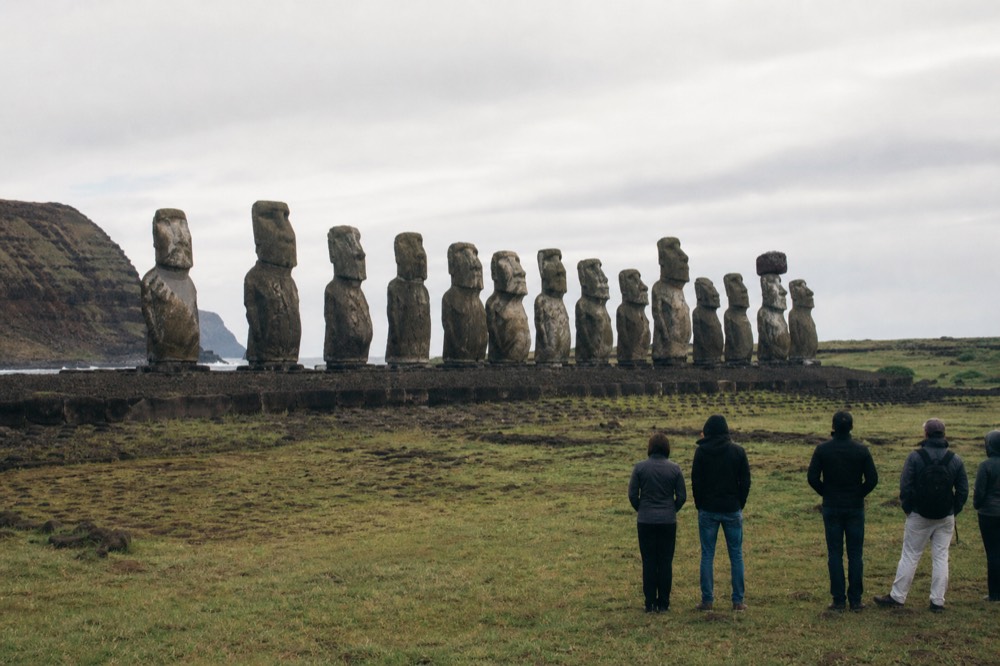
Practically, that argues for the slower products rather than the fastest ones. A private archaeology day gives you the time to stand still, which is the whole point at a site where you cannot do anything else, and travellers who want that pace can compare what a private archaeology day costs on their dates. For the standard circuit that links the quarry, the big platform and the north coast in one run, check what the full-day route costs on your dates, and for the ceremonial-village side of the island, see which Orongo departures are still open, remembering that Orongo is single-entry too.
The version of this that sticks is not the fine. It is the reframing. Ask anyone who has stood on the plaza at Tongariki at dawn whether they wanted to touch a statue, and the answer is usually that the thought never came up, because somebody had explained whose faces those are. That is the real enforcement mechanism, and the reason every bookable tour on the island goes out with a local guide.
Match The Day To Your Plans And Compare Costs
Editorial starting point. Confirm your party's age, access needs and departure details on the listing.
Full-Day Rapa Nui Circuit: Vaihu, Akahanga, Rano Raraku, Tongariki and Anakena in one guided day. Booking details: Park ticket, food and drinks are extra. Moderate fitness required; review the operator’s health restrictions. 8–9 hours
Private History Of The Moai: A private moai-history route through the quarry and coastal platforms; a water bottle is listed. Booking details: Confirm park admission, meal arrangements, party eligibility and access needs before booking. 7 hours
Compare Your Actual Quotes
Same dates, party, currency and inclusions. Compare guided routes; park entry may be extra.
Compare actual shared and private quotes. A price difference does not establish equivalent service.