What is the tragedy of Easter Island?
Two different tragedies get told as one. What the collapse story claims, what recent DNA and archaeology say, and the documented human catastrophe of the 1800s.
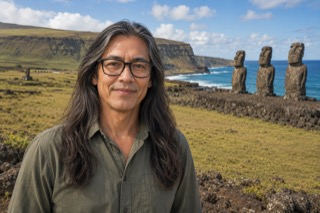 By Pedro Pakarati, Rapa Nui tour guide and archaeological specialist
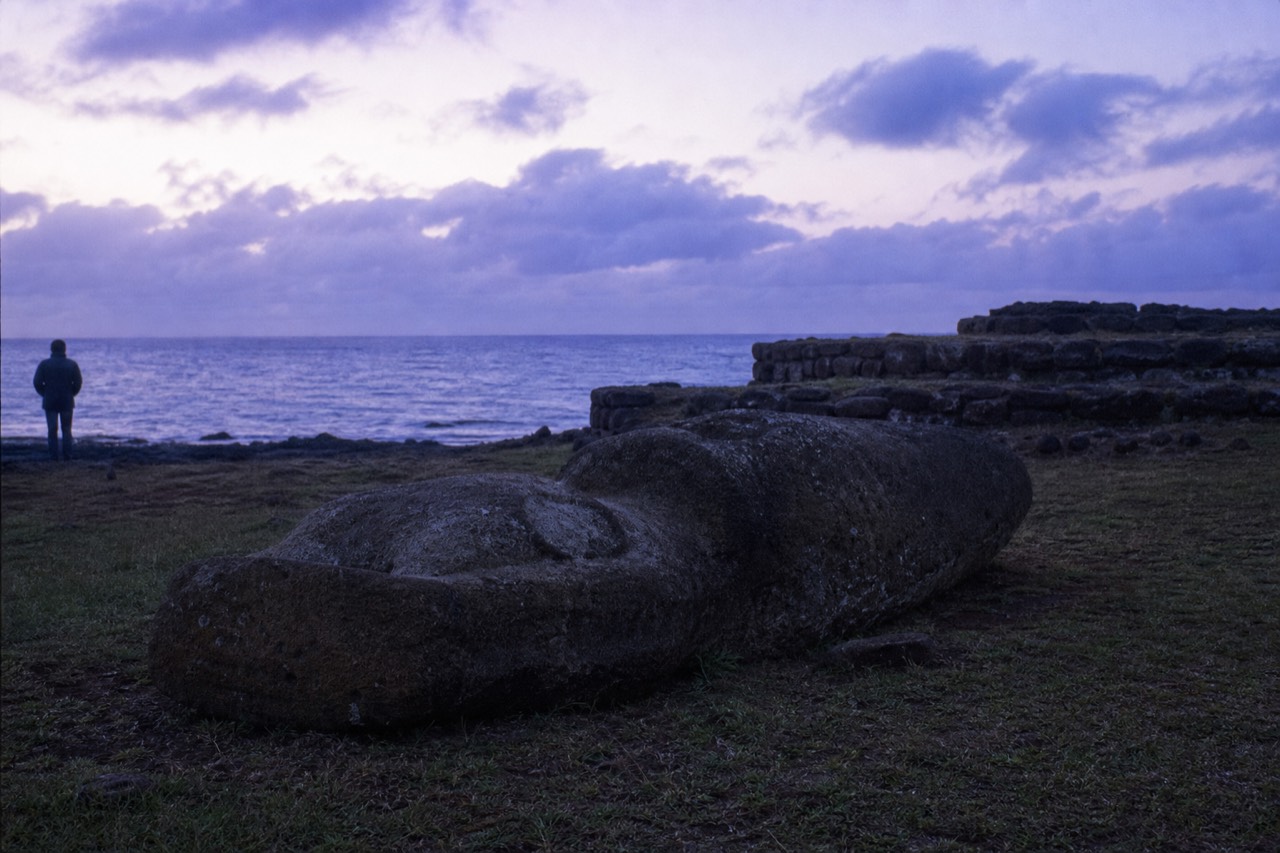
Along the south coast the moai are lying down. Not fallen at odd angles, not eroded into stumps, but face down in the grass in front of their own platforms, with their red topknots rolled away separately. Vaihu alone holds eight of them on one of the longest ahu on the island. Every statue standing on Rapa Nui today, with a handful of exceptions, was put back up in the twentieth century by archaeologists.
That is the physical record of whatever happened here. What it means is one of the most argued questions in Pacific archaeology, and the popular answer has been losing ground for a decade.
What do people mean by the tragedy of Easter Island?
Usually one of two different things. The first is an ecological parable: an isolated society cut down its forests to move statues and destroyed itself. The second is documented history: nineteenth-century slave raiding, deportation, imported epidemics and annexation, which came close to ending the Rapa Nui people entirely. The second is far better evidenced than the first.
The parable is the one that travels. It appears in school curricula, popular science books and about half the YouTube videos on the subject, always with the same beat: the islanders were their own undoing. It is a satisfying shape for a story, and it flatters the teller, because the moral is always aimed at somebody else's civilisation. None of it appears in the way the island is actually described in its UNESCO World Heritage listing, which deals in ceremonial architecture and around 300 ahu platforms rather than morality tales.
The history is messier and harder to summarise, which is exactly why it gets skipped. It has no neat lesson, no single villain the audience can feel superior to, and it implicates the outside world rather than the island.
Does the evidence support the collapse story?
Partly. The forests really did disappear, and largely before Europeans arrived. What is contested is the cause and the consequence. Recent work assigns significant weight to Polynesian rats eating palm seeds alongside human clearing, and a 2024 ancient DNA study found no genetic evidence of the population collapse that the ecocide narrative requires.
| The claim | Where the evidence sits now |
|---|---|
| The island lost its palm forest | Supported. The palms at Anakena today were planted in 1960 and imported; the original forest was largely gone before European contact |
| People cut it all down for statue transport | Partly. 2025 studies of transport and deforestation put real weight on Polynesian rats consuming palm seeds alongside human clearing |
| Society collapsed before Europeans arrived | Contested. A 2024 ancient DNA study found no evidence of the pre-contact collapse the narrative depends on |
| Statue carving stopped abruptly | Supported by the quarry itself, where around 400 figures sit at various stages, one still attached to bedrock |
| The moai were pulled down in conflict | Supported. The park attributes the toppled moai at Akahanga to ancient village life and the civil wars of the 18th century |
| The population crashed catastrophically | Supported, but in the 1800s and for reasons that arrived by ship |
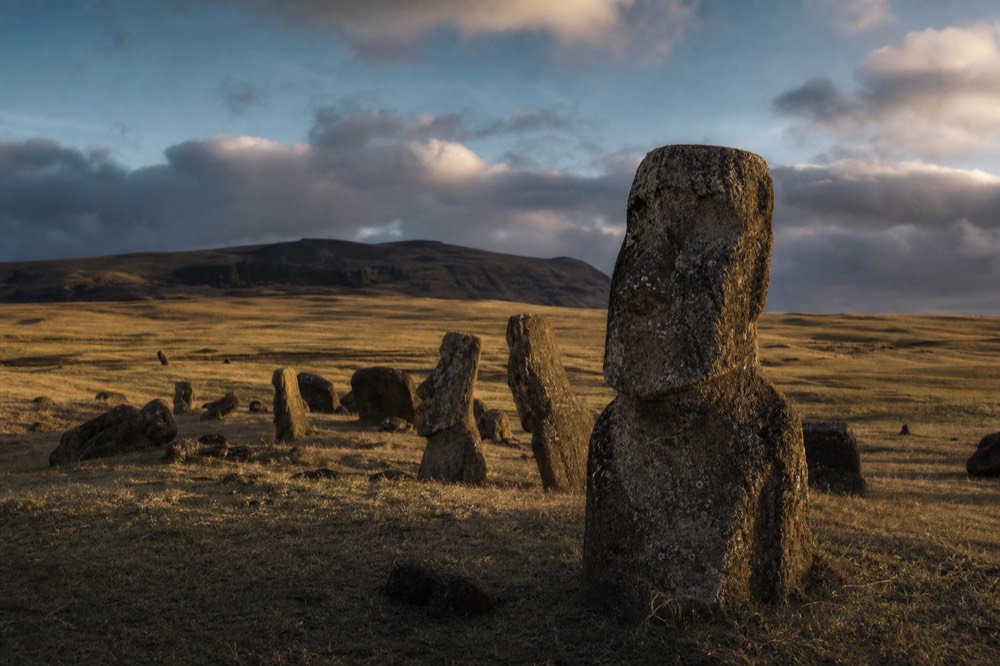
Read that table as a whole and a different picture emerges. A society lost its trees, adapted its farming, kept feeding itself and kept building until it chose to stop building. That is not collapse. It is adaptation under hard constraints, which is a considerably more impressive story than the one usually told, and it is the version islanders themselves have been arguing for since long before the genetics caught up. Why the carving stopped is a separate question with its own evidence.
What actually happened to the Rapa Nui people?
Slave raiding out of Peru in the 1860s took islanders off the island, and the few who came home carried epidemic disease into a population with no immunity. Between the raids, the deaths and the emigration that followed, the Rapa Nui were reduced to a remnant. Chile annexed the island in 1888, and generations lived under an administration that confined them to Hanga Roa.
This is the tragedy with names, dates and paperwork. It is also the one that explains what a visitor sees today: a culture that survived a bottleneck narrow enough that almost every Rapa Nui family alive traces back through it, and a fierce contemporary insistence on running their own heritage.
The knock-on losses were cultural as much as demographic. When a population falls that far that fast, the people carrying specialist knowledge go with it: the carvers, the chanters, the readers of rongorongo. Radiocarbon dating published in 2024 placed one rongorongo inscription at roughly 1493 to 1509, before European contact, which strengthens the case that the script was invented independently on the island. Nobody today can read it fluently. That is not a mystery about ancient people. It is a direct consequence of what happened in the 1860s.
Why are so many moai lying face down?
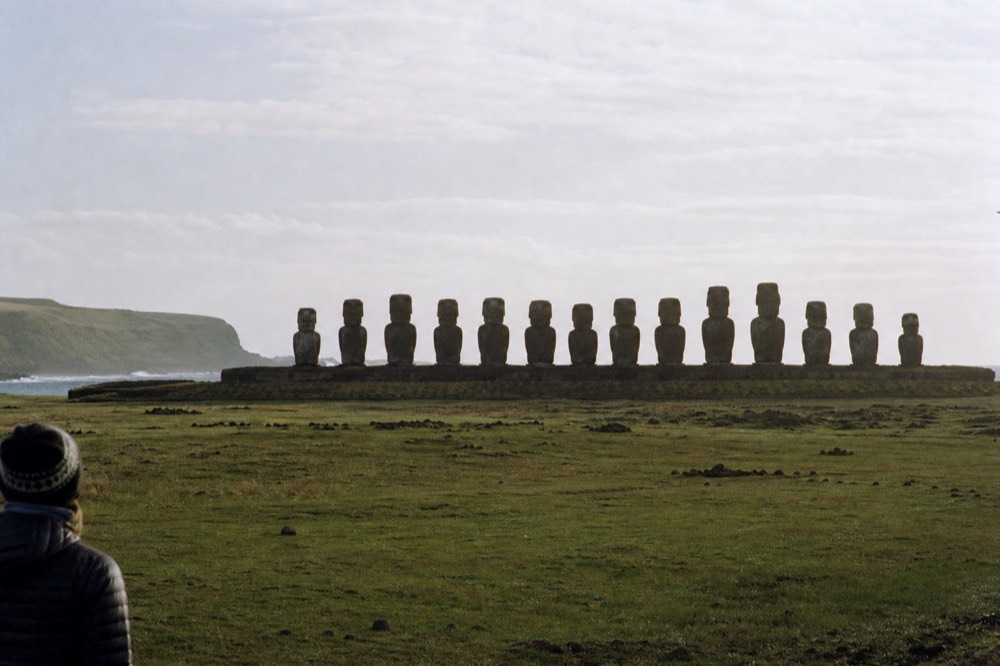
Because islanders pulled them down. The national park attributes the fallen statues at Akahanga to the civil wars of the 18th century, and Vaihu holds eight toppled moai on one platform as testimony to historic conflict. The statues at Tongariki are a separate case: a tsunami scattered them, and a restoration team backed by Japanese donations re-erected all fifteen in the 1990s.
The most eloquent single object on the island is Paro at Te Pito Kura. It is the tallest moai ever raised on a platform, close to 10 metres and around 82 tonnes, hauled all the way from the quarry with an enormous red topknot, and it is still lying where it fell. Nobody has ever put it back. Standing beside a statue that large on its face, with its pukao a few metres away, does more to explain the end of the statue era than any documentary.
The order in which you meet these places changes what they mean. Take the south coast circuit as it runs, Vaihu and Akahanga first with their fallen giants, then Rano Raraku full of figures that never left the quarry, then Tongariki standing restored against the sunrise, and the sequence tells itself. Anyone who wants that walked through carefully rather than at van pace should compare what a private archaeology day includes against the standard full-day circuit.
Is there a modern chapter to this?
Yes, and it is ongoing. A wildfire tore through Rano Raraku in October 2022 and charred around 80 moai, with heat damage reaching up to 10 centimetres below the stone surface on the worst-hit figures and some damage described as irreparable. Community conservators began treating the five most damaged statues in May 2025.
| The 2022 fire and after | What is documented |
|---|---|
| Moai charred or cracked | Around 80 by preliminary estimate; some reports cite closer to 100 |
| Statues with significant damage | Around 22 |
| Depth of heat effects | Up to 10 centimetres below the surface on the worst-affected stone |
| International response | UNESCO Heritage Emergency Fund support, roughly $97,000 in 2023, plus a risk-management plan |
| Physical conservation | Began May 2025 on five moai: soot removal, lichen control, stone strengthening, water-repellent treatment |
| Who is doing the work | Ma'u Henua conservators, using methods developed with University of Florence restorers |
| Access today | Restored; scarring is visible on site and monitoring continues |
Because Rano Raraku admits you only once per park ticket, the fire scarring is something you get one look at, which is an argument for taking the quarry slowly. Anyone building a first visit around it should check how long the full-day circuit gives you at the quarry before booking on price alone.
The fire matters beyond the damage because of who answered it. The park has been administered since 23 November 2017 by Ma'u Henua, the island's indigenous community, under a 50-year concession backed by more than 86% support in an indigenous consultation. When the moai burned, the people who fought for control of their own heritage were the ones cleaning soot off their ancestors, with the BBC reporting on that restoration work in July 2025.
Why does the resilience framing matter to visitors?
Because the people in the story are still here, running the place. Framing Rapa Nui as a cautionary tale about a vanished society erases 2,500 community members, 280 park employees and a culture that is being actively defended. How you talk about the island while you are on it is part of the visit.
There are practical edges to this. Touching, leaning on or climbing a moai is prohibited and carries fines of 5 to 100 UTM under Chile's national monuments law, drones need authorisation, and the park's own rules make an accredited local guide mandatory to enter any site. Those rules are not bureaucratic decoration. They exist because the objects in question are ancestors to the people who wrote the rules, and because roped-off distances are the only defence a soft volcanic stone has against a hundred thousand visitors in a good year. The reasoning behind the no-touching rule is worth reading before you go.
The counterweight to a tragedy is what survived it. The language is still spoken, Tapati fills two weeks of the calendar every summer, the arrival of Hotu Matu'a at Anakena is commemorated every 7 July, and the earth-oven curanto is a family dish rather than a heritage performance. Who lives on the island today answers the part of the story the parable leaves out, and the full lineup of bookable island tours is the practical end of it.
Come for the moai by all means. Just be careful which tragedy you think you are looking at, because the one written on those south-coast platforms is not the one you were probably told.
Match The Day To Your Plans
Editorial starting point. Confirm your party's age, access needs and departure details on the listing.
Full-Day Rapa Nui Circuit: Vaihu, Akahanga, Rano Raraku, Tongariki and Anakena in one guided day. Booking details: Park ticket, food and drinks are extra. Moderate fitness required; review the operator’s health restrictions. 8–9 hours
Easter Island Highlights In Two Days: Quarry and coastal moai on one day; Orongo, Puna Pau, Ana Te Pahu and Akivi on the other. Booking details: Site admission and lunch are extra. Confirm terrain and vehicle suitability for your party. 2 days