Are Hawaiians related to Rapa Nui?
Yes, and closely. Two corners of one Polynesian triangle, related languages, a shared voyaging tradition, and an origin story that starts with a canoe.
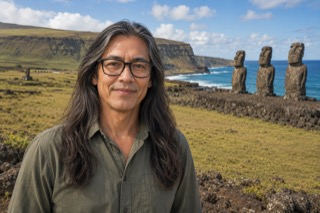 By Pedro Pakarati, Rapa Nui tour guide and archaeological specialist
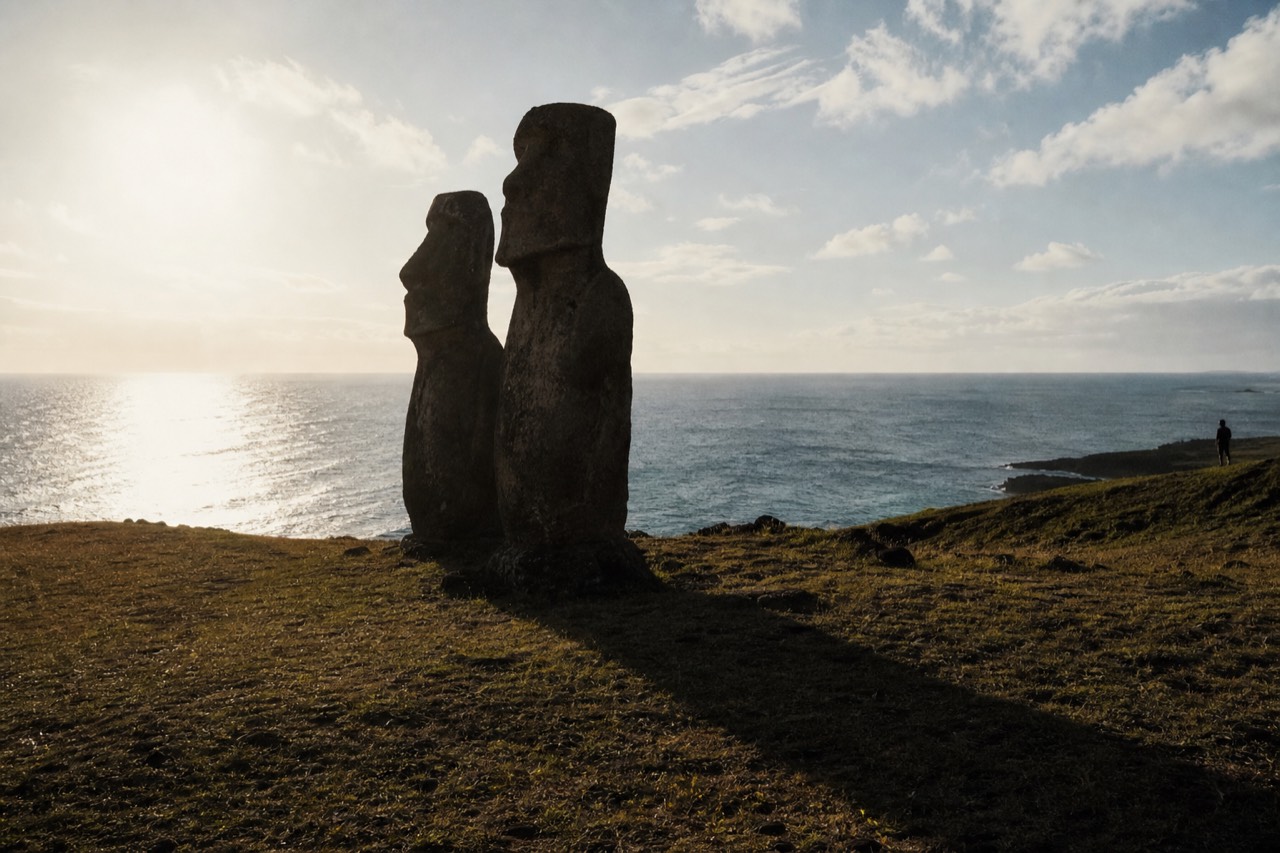
Every 7 July, the Rapa Nui community gathers at the beach at Anakena to mark the arrival of the ariki Hotu Matu'a. The ceremony opens with an umu, a blessing cooked in an earth oven, and the chants and dances retell a voyage: Haumaka's vision of the sinking homeland of Hiva, a canoe navigated by the stars, a landing at Hanga Rau, the birth of the first Rapa Nui child on that sand.
Anyone who has stood at a Hawaiian cultural ceremony will recognise the architecture of that story immediately. That recognition is not a coincidence, and it is not vague new-age kinship. It is genealogy.
Are Hawaiians and the Rapa Nui the same family?
Yes. Both are Polynesian peoples, occupying two corners of the Polynesian triangle: Hawaii at the northern point, Rapa Nui at the southeastern one, Aotearoa New Zealand at the southwestern. Their ancestors came out of the same long expansion of ocean-going settlers across the eastern Pacific, and their languages belong to the same branch of the same family.
The scale is worth pausing on. Rapa Nui sits roughly 2,200 miles from the nearest city, one of the most isolated inhabited places on the planet, and Hawaii sits at the far end of a comparable stretch of empty water. The people who reached both did it with sailing canoes, star knowledge and provisioning for weeks at sea. The moai are the famous achievement here. Arriving at all was the harder one.
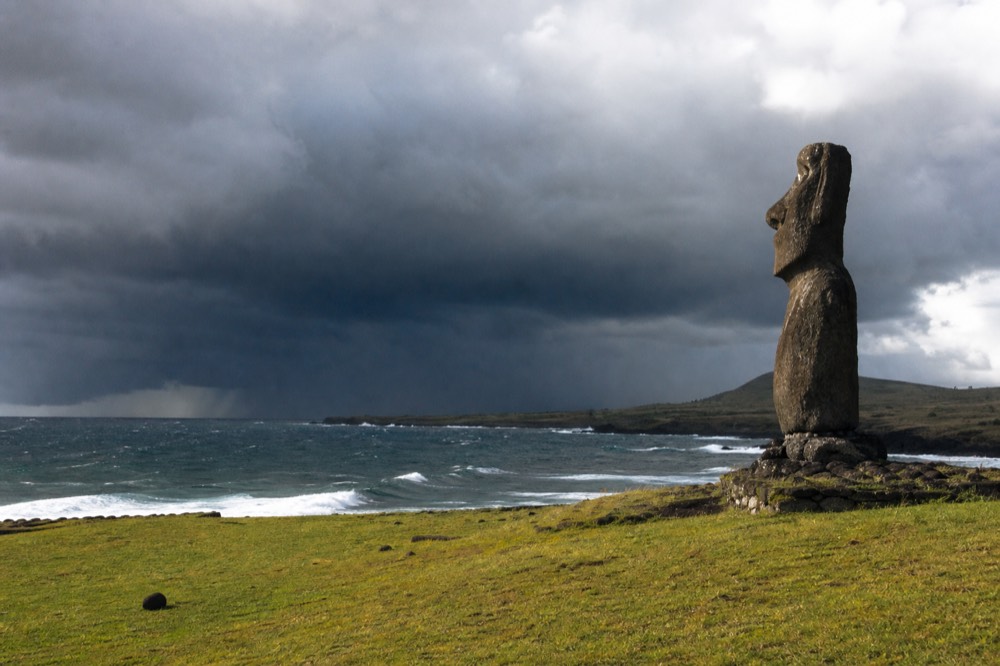
What makes Rapa Nui unusual within the family is not its ancestry but its isolation after arrival. Hawaiian, Tahitian and Māori societies kept contact with neighbours for centuries. Rapa Nui had none within reach, and the moai developed in that separation.
How close are the languages?
Close enough to recognise. Rapa Nui belongs to the Eastern Polynesian branch alongside Hawaiian, Tahitian and Māori, and it remains the island's cultural language today, spoken beside Spanish, which is the official one. English is widely used across the tourism trade.
You meet the language as place names before you meet it as speech, and the vocabulary does most of the explaining.
| Rapa Nui word | What it means | Where you meet it |
|---|---|---|
| iorana | Greeting, welcome | The first word on the park's own signage |
| māuru-uru | Thank you | Closing line of the park rules |
| ahu | Ceremonial platform | Ahu Tongariki, Ahu Akivi, Ahu Nau-Nau |
| moai | The carved ancestor figures | Every site on the island |
| pukao | The red topknot on a moai | Quarried at Puna Pau |
| rano | Volcanic crater | Rano Raraku, Rano Kau |
| motu | Islet | Motu Nui, Motu Iti, Motu Kao Kao, off Orongo |
| ariki | Chief or king | Ariki Hotu Matu'a, the founding navigator |
| tangata manu | Birdman | The cult centred on Orongo |
| umu | Earth oven, and the meal cooked in it | Curanto, the island's communal dish |
| kāinga | Land, homeland | Te Pito o te Kāinga, the island's own name for itself |
Read the middle column and the family resemblance stops being abstract. Ariki is the word that appears as ali'i in Hawaiian and ariki in Māori: the chiefly line, the inherited authority. Umu names the earth oven from one end of Polynesia to the other, whether the meal on the stones is a Hawaiian imu feast or a Rapa Nui curanto of tuna, sweet potato and taro in banana leaves.
What does the island's own settlement story say?
That the first Rapa Nui arrived by canoe under a navigator called Hotu Matu'a, guided by the stars, after a seer named Haumaka dreamed of the sinking of the homeland Hiva. They landed at Hanga Rau, the beach known today as Anakena, where the first Rapa Nui child, Tu'u Maheke, was born. The community commemorates it every 7 July.
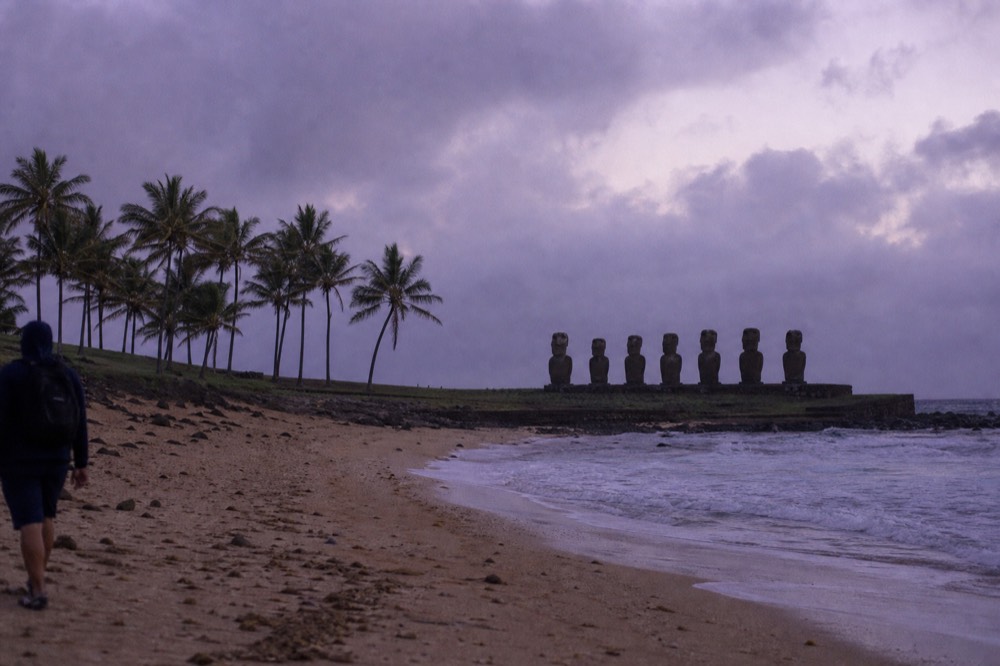
Anakena is where that tradition is anchored in the ground. The beach carries Ahu Nau-Nau and its moai, and it is one of the few proper swimming beaches on an island otherwise ringed by black rock, which is exactly the landing site a navigator would choose after weeks at sea. The palms shading it today were planted in 1960 and imported, long after the island's original forest had gone, so the postcard version of the landing beach is a modern replanting on an ancient site.
Oral tradition is not archaeology, and the island's own historians are clear about the difference. What the two agree on is the direction of travel: people came from the west, across open ocean, deliberately.
What do DNA and archaeology add?
Genetics has been busy on Rapa Nui, though the headline finding of recent years is about collapse rather than kinship: a 2024 ancient DNA study found no evidence for the ecocide population crash the popular narrative assumes. Separately, radiocarbon dating published in 2024 placed a rongorongo inscription at roughly 1493 to 1509, before European contact.
The archaeology is doing steadier work than the genetics. The Easter Island Statue Project's inventory has logged 1,040 monolithic sculptures, and the pattern in that catalogue, the forms, the sites, the sequence of styles, is the raw material every origin argument has to answer to.
That rongorongo date matters to the family question more than it looks. The script, carved on wooden tablets and unreadable today, has long been suspected of being invented after Europeans showed islanders writing. Dating an inscription to before contact supports the opposite case: an independent invention of a writing system by a Polynesian society, one of very few anywhere in the world.
The other claim you will meet constantly, that Rapa Nui had early contact with South America, is an active research question rather than a settled fact, and the honest position is that the genetic literature keeps moving on it. Any page quoting you a precise percentage of anything should be read carefully, this one included. What is not in dispute is the Polynesian core: the language, the social structure, the voyaging technology and the founding tradition all point the same way.
For visitors, the practical version of all this is that the island's story is legible on the ground if someone walks you through it. It is worth seeing what the two-day package covers across both circuits, because the landing beach and the ceremonial village sit on opposite sides of the island.
What does the night sky have to do with it?
Everything, because the sky is how anyone got here. Rapa Nui's isolation gives it a night sky with effectively no light pollution, and evening astronomy sessions on the island pair the southern constellations with the Polynesian navigation history that put people on this rock in the first place.
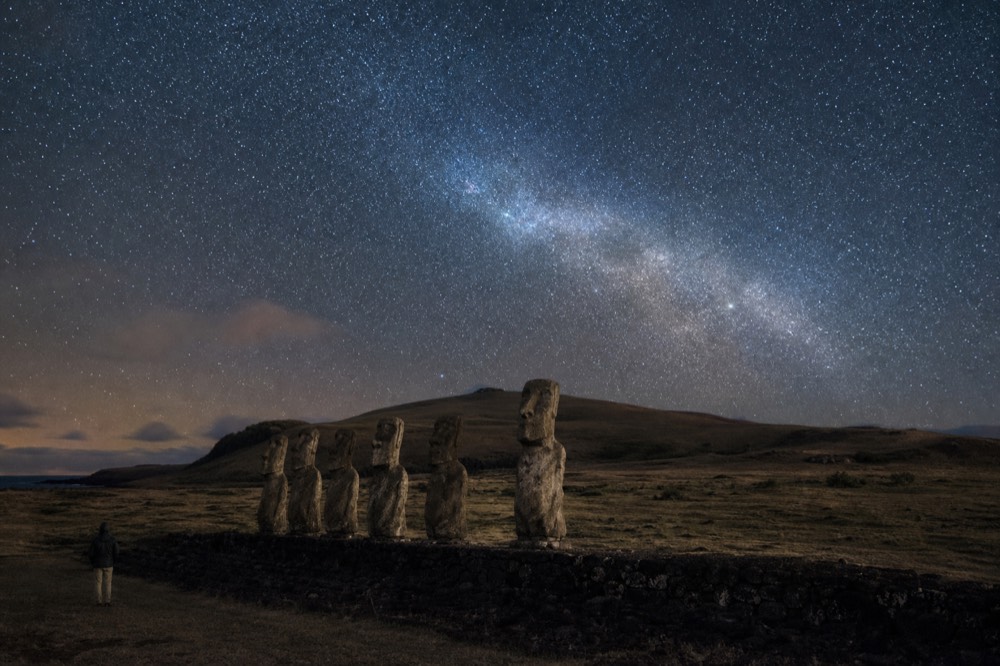
The sky over the island shows the Southern Cross, the Magellanic Clouds and a Milky Way that northern latitudes never see, and the clearest conditions run roughly April to October. Sessions time themselves around the moon: a full moon washes out everything a telescope is there to show.
The island also built its own instrument. Ahu Akivi's seven moai are the only ones facing the sea, and they align with the solar trajectory at the equinoxes, which is why the site is described as an astronomical observatory rather than only a ceremonial platform. A people who navigated thousands of miles by star path, then set their statues to mark the sun's turning points, are behaving exactly like the Polynesian societies at the other corners of the triangle.
Where on the island does this story stand up?
On both circuits, which is why one day is not enough for it. The landing beach, the quarry and the great platforms sit on the south and east run. Orongo, the birdman village and the topknot quarry sit on the Rano Kau side. A two-day package covers both, and an accredited local guide is required at every one of them.
| Site | What it holds | Which circuit reaches it |
|---|---|---|
| Anakena, or Hanga Rau | Landing beach of Hotu Matu'a, Ahu Nau-Nau and its moai | South and east day |
| Rano Raraku | The main quarry, around 400 statues at various stages | South and east day |
| Ahu Tongariki | Fifteen moai on the largest restored platform on the island | South and east day |
| Te Pito Kura | Paro, the largest moai ever moved from the quarry, with its huge pukao | South and east day |
| Ahu Akivi | Seven moai facing the sea, aligned with the equinox sun | Rano Kau day |
| Orongo | Ceremonial village of the birdman cult, above Motu Nui | Rano Kau day |
| Puna Pau | The red scoria quarry where most pukao were cut | Rano Kau day |
| Ana Te Pahu | Lava-tube cave used as refuge and store, with traditional gardens | Rano Kau day |
The whole ensemble sits inside a UNESCO World Heritage property with roughly 300 ahu platforms, and the park's rules make an accredited guide mandatory at every site above. Two further notes shape how you plan the visit. Rano Raraku and Orongo each admit you once per park ticket, so neither can be repeated later in the week, and the $100 adult ticket runs 10 consecutive days from issue. The ticket rules in full cover the child rate and the single-entry trap, and the itinerary guide maps three, four and five-day plans onto real departures.
If the star-path side of the story is what pulled you in, consider a night session, remembering that it is weather-dependent and best away from a full moon. The stargazing guide covers the seasons and what the southern sky shows.
Two peoples, two corners of one ocean, one navigation tradition. Standing on the sand at Anakena where the canoe is said to have landed makes that family tree feel a lot less theoretical.
Match The Day To Your Plans
Editorial starting point. Confirm your party's age, access needs and departure details on the listing.
Full-Day Rapa Nui Circuit: Vaihu, Akahanga, Rano Raraku, Tongariki and Anakena in one guided day. Booking details: Park ticket, food and drinks are extra. Moderate fitness required; review the operator’s health restrictions. 8–9 hours
Rapa Nui Dinner And Dance Show: Umu Pae cooking presentation, buffet dinner, Haha Varua music and dance, and return transport. Booking details: Alcohol and gratuities are extra. Published age bands begin at 6; confirm dietary needs before booking. 3 hours