Easter Island stargazing: the southern sky from 2,200 miles of open ocean
There is no city glow to hide behind out here, because the nearest one is a five-and-a-half-hour flight away, and the sky above Rapa Nui behaves accordingly.
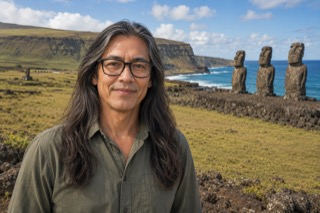 By Pedro Pakarati, Rapa Nui tour guide and archaeological specialist
Short answer
Rapa Nui sits about 2,200 miles west of mainland Chile with almost no artificial light beyond one small town, which makes the night sky exceptional. The southern view includes constellations, planets and a Milky Way that never rise from northern latitudes. Guided sessions run around 3.5 hours with telescopes and Polynesian navigation history, and April to October brings the clearest conditions.
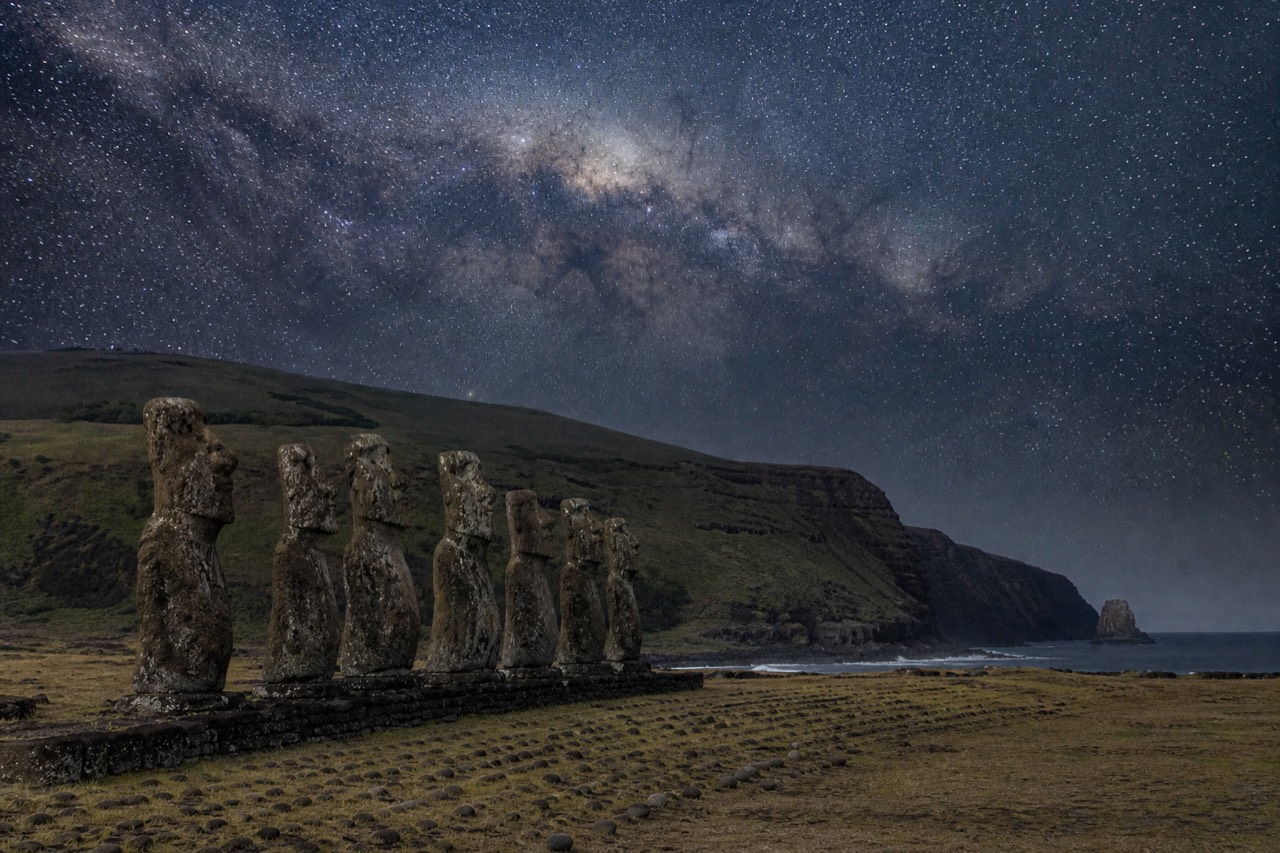
Step out of a guesthouse in Hanga Roa after the last restaurant closes and the difference is immediate. Not that the stars are brighter, exactly. There are simply more of them, packed into the gaps where a mainland sky has nothing, and the Milky Way stops being a faint smear and becomes a structured band with dark lanes running through it.
This is a function of geography rather than altitude. Rapa Nui is not a high desert observatory site. It is a low volcanic island of about 63 to 67 square miles, topping out at Ma'unga Terevaka at 1,663 feet, with one town, a single airstrip and roughly 2,200 miles of empty Pacific between it and the nearest city lights on the Chilean coast. Its closest inhabited neighbour, Pitcairn, sits some 1,290 miles the other way and has no glow worth mentioning either.
How dark is the night sky over Rapa Nui?
Dark enough that light pollution stops being the limiting factor and cloud takes over. The island is one of the most isolated inhabited places on Earth, about 2,200 miles from mainland Chile, with artificial light confined to a single small town. No verified Bortle-scale rating for the island has been published, so any specific number you see quoted for it is a guess rather than a measurement.
That honesty matters, because dark-sky marketing loves a number. What can be said with confidence is structural. There is no metropolitan dome on any horizon, because there is no metropolis within thousands of kilometres. There is no industrial corridor, no motorway lighting, no airport running night operations. Walk fifteen minutes out of Hanga Roa and the only light behind you is the town itself, which is small enough to duck behind a ridge.
| What controls the darkness here | The situation on Rapa Nui | Effect on what you see |
|---|---|---|
| Distance to the nearest city lights | About 2,200 miles to mainland Chile | No sky glow on any horizon |
| Nearest inhabited neighbour | Pitcairn, roughly 1,290 miles east | Nothing to contribute light from either direction |
| Local settlement | One town, Hanga Roa, on a 63 to 67 square mile island | A single small glow that is easy to walk away from |
| Terrain | Three extinct volcanoes, high point Ma'unga Terevaka at 1,663 feet | Ridges that block the town glow without needing altitude |
| Published dark-sky rating | None verified | Treat any quoted Bortle number as unsourced |
| The real limiting factor | Cloud and passing rain, not light | Sky quality varies night to night, not location to location |
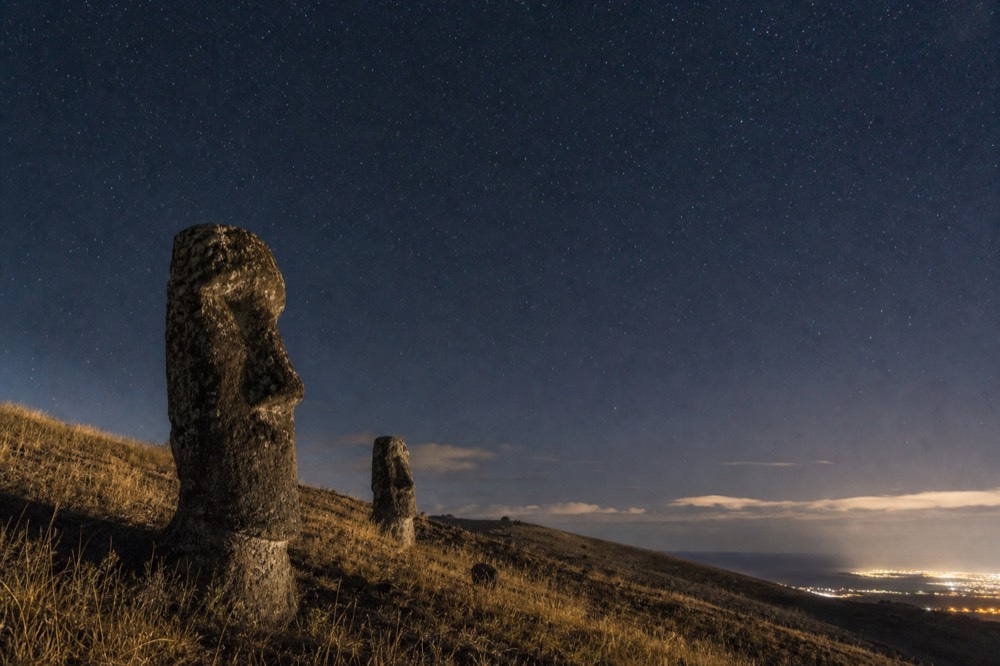
The practical consequence is that your night is decided by weather rather than by where you stand. On the mainland, stargazing planning is mostly about escaping light. Here, escaping light takes about ten minutes, and the entire remaining question is whether the trade winds have pushed a band of cloud across at the wrong moment. That flips the usual advice: do not spend energy hunting a darker spot, spend it on having more than one candidate night.
Rain falls year-round on Rapa Nui with real month-to-month variability, which is the reason no operator can promise a sky. It is also why holding a session early in a stay is the single most useful scheduling decision, since a washed-out first attempt leaves room for a second.
What can you see here that you cannot see from home?
The entire southern celestial hemisphere. From Rapa Nui the sky includes constellations, stars and planets that never rise above the horizon at northern latitudes, along with the two Magellanic Clouds and a Milky Way core that climbs far higher than a northern observer ever sees it. The Southern Cross, invisible from most of North America and Europe, is a permanent fixture here.
For a traveller arriving from the northern hemisphere this is the part that genuinely surprises people. It is not a better version of a familiar sky. It is a different sky, rotating the other way, with unfamiliar anchor points and a galactic centre that sits high overhead instead of scraping the southern horizon.
| What is up there | Visible from mid-northern latitudes? | Why it matters here |
|---|---|---|
| The Southern Cross | No, not from most of North America or Europe | The classic southern navigation marker, up and obvious |
| Large and Small Magellanic Clouds | No | Two satellite galaxies visible to the naked eye under dark sky |
| Milky Way galactic core | Only low on the horizon, through thick atmosphere | Climbs high overhead, showing dust lanes and structure |
| Southern circumpolar constellations | No | An entire set of star patterns most visitors have never seen |
| Planets along the ecliptic | Yes, but at different angles | Familiar objects in unfamiliar positions and orientations |
| Polynesian star lines and wayfinding markers | Not as a cultural framework | Guides teach the sky the way it was used to find this island |
The cultural layer is what separates a Rapa Nui night from a generic dark-sky night, and it is not decoration. Polynesian voyagers reached the most remote inhabited island on the planet using this sky, and a guided session on Rapa Nui typically covers that navigation history alongside the telescope work. Learning which stars mattered to the people who carved the statues you looked at that afternoon is a better narrative than any list of Messier objects.
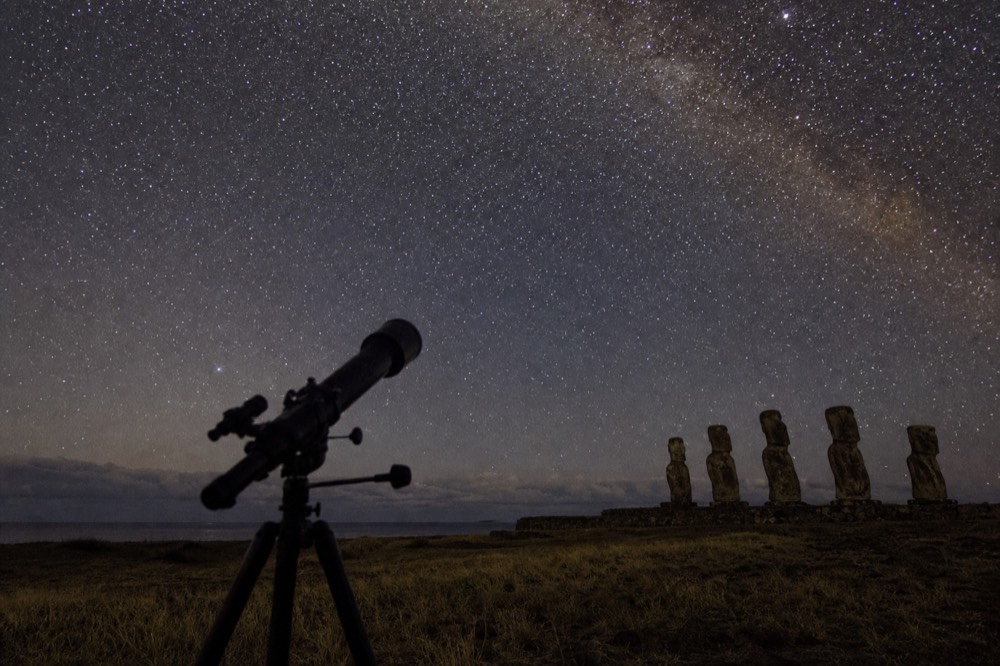
The naked-eye targets do most of the work. Both Magellanic Clouds read as soft patches once your eyes have adapted, and neither requires equipment. The telescopes on a session add planets, star clusters and double stars, which is where a guide earns their keep, since finding those from scratch on an unfamiliar sky is slow. Anyone coming for the moai and treating the sky as a bonus tends to leave with the ranking reversed, which is why the wider list of what fills a Rapa Nui day puts the night session higher than most itineraries do.
When is the best time of year for stargazing on Rapa Nui?
April to October brings the clearest conditions for the island's astronomy sessions, and those are also the cooler months, with August lows around 15 to 17 degrees Celsius. The honest caveat is that rain falls year-round with real variability, and some of the wetter stretches fall inside that window, so no month is a guarantee.
Rapa Nui has a subtropical oceanic climate with a narrow temperature range: the annual average sits around 20 to 21 degrees Celsius, or 68 to 70 Fahrenheit, with February highs near 27 to 28 and August lows near 15 to 17. Trade winds blow more or less constantly. That combination produces mild nights all year and a sky that can change inside an hour.
| Period | Temperatures | Rain and sky notes | Sunrise band | Verdict for a night session |
|---|---|---|---|---|
| December to February | Warmest, highs near 27 to 28C in February | Rain lower in some summer months, but warm and humid | Around 6:30 AM | Comfortable nights, shortest darkness, busiest season |
| March | Sea at its warmest, 25 to 27C | Transitional | Between the two bands | Good pairing of swimming days and dark nights |
| April to May | Cooling | Among the wetter stretches despite falling inside the clear-sky window | Between the two bands | Clear nights are excellent, but hold a backup evening |
| June to August | Coolest, lows around 15 to 17C | Variable, with July among the wetter months | Around 7:30 AM | Longest nights and the widest pre-dawn window |
| September to October | Warming again | Generally settled, tail of the clear window | Between the two bands | The quiet sweet spot: fewer visitors, long nights |
| November | Warming | Shoulder | Between the two bands | Workable, with darkness starting to shorten |
Two things follow from that table. The first is that winter, meaning June to August in the southern hemisphere, gives you the most usable dark hours per night, because sunrise slips to around 7:30 AM and the evening starts earlier. The second is that the temperature spread across the whole year is about ten degrees, so "cold" here means a fleece and a windproof layer rather than a serious cold-weather kit.
Season choice interacts with the rest of a trip more than it interacts with the sky. The month you pick governs sea temperature, crowd levels, flight pricing and whether the Tapati festival is running, and the month-by-month case for when to come works those trade-offs properly. If the night sky is the reason for the trip rather than a bonus, the April to October band is the one to aim at, with a session date checked against your stay rather than assumed to run every evening.
How much does the moon matter?
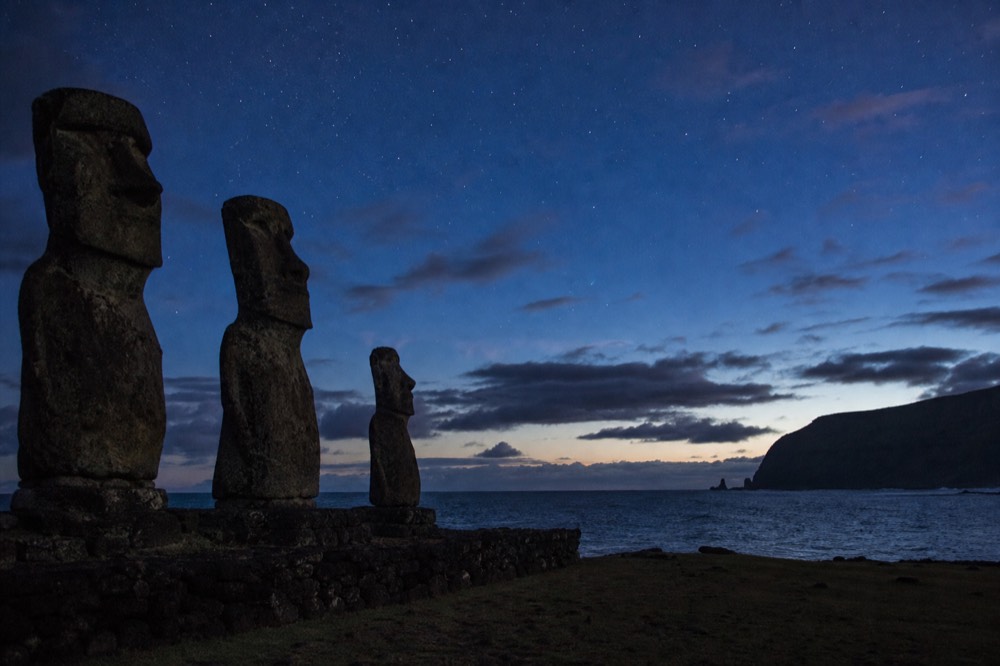
More than the month does. A full moon washes out the Magellanic Clouds and flattens the Milky Way no matter how dark the island is, while the nights around new moon give the sky its full depth. No island-specific moon guidance is published for Rapa Nui, so the standard rule applies: aim for the darkest phases and check a moon calendar against your travel dates.
This is the planning step most visitors skip, and it costs them more than choosing the wrong season. Light pollution here is close to zero, which means the moon is by far the brightest artificial-feeling light source in the sky, and it is entirely predictable months in advance.
| Moon phase | What it does to the sky | Best use of the night |
|---|---|---|
| New moon | Darkest sky of the cycle; Magellanic Clouds and Milky Way structure at their strongest | The nights to protect for a session or for wide-field photography |
| Waxing or waning crescent | Faint moonlight, sets or rises well away from the middle of the night | Still excellent; time the session for the moonless half of the night |
| First or last quarter | Half the night is dark, half is washed | Workable, but ask which side of midnight the session falls on |
| Gibbous | Deep-sky targets fade badly | Better for planets, the moon itself and bright double stars |
| Full moon | Milky Way largely lost, faint objects gone | Landscape and moai-under-moonlight photography rather than deep sky |
The useful trick is to treat the moon calendar as a filter on the whole trip rather than on one evening. Flights to the island run on a limited schedule, typically five or more services a week, so a stay tends to be shaped in blocks of several days. Sliding that block by three or four nights can move it from a gibbous moon to a crescent, which is a far bigger upgrade than any change of location on the island could deliver.
A quarter moon is not a write-off. Half the night is genuinely dark, and whether that is the first half or the second depends on which quarter it is. Asking the operator which part of the night the session covers is a sensible question, and one a local astronomy guide can answer instantly.
What actually happens on a stargazing session?
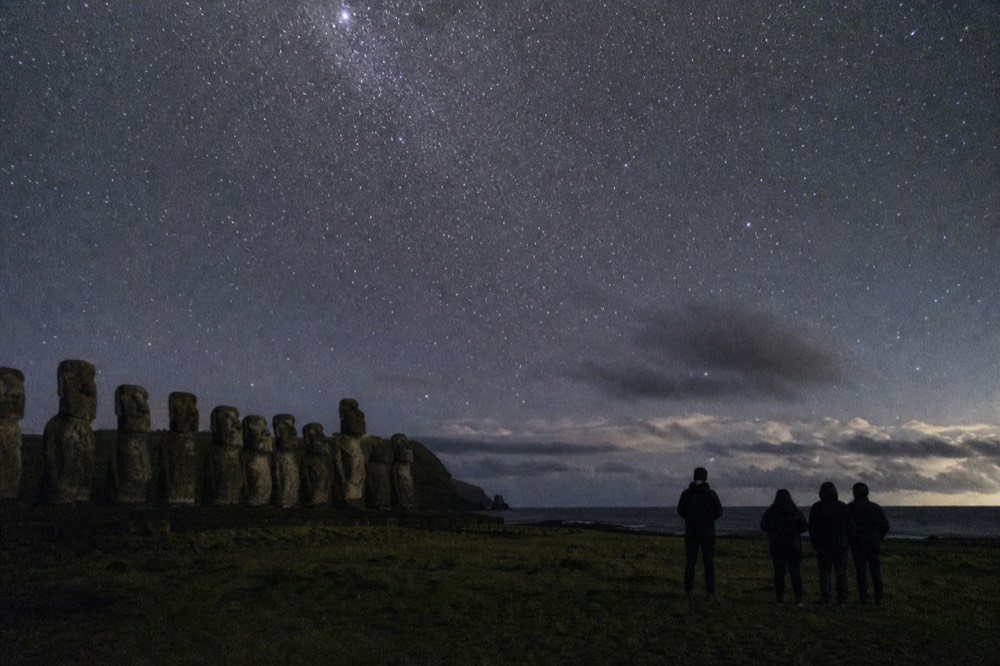
A guided Rapa Nui astronomy night runs around three and a half hours. Groups move away from the town glow, set up telescopes, and work through planets, clusters and the naked-eye southern objects, with the island's Polynesian navigation history woven through it. Sessions depend on the sky, so a weather call is normal rather than a red flag.
The shape is consistent across operators. A pickup or meeting point in Hanga Roa, a short transfer to open ground away from the last streetlight, a period of naked-eye orientation while everyone's night vision develops, then telescope time, then the drive back. Three and a half hours sounds long on paper and does not feel long in practice, because roughly the first twenty minutes go entirely to your eyes adapting.
Two details are worth knowing before you book. The first is the weather policy: an operator who cancels for cloud is doing the right thing, and on an island where rain arrives year-round that will happen to somebody every week. Book the session for early in your stay so a cancelled night can be rerun. The second is that this is one of the few island activities that is genuinely better in a small group, because telescope time is divided by however many people are queuing for the eyepiece.
The session sits outside the park's operating day. Rapa Nui National Park sites generally run from around 6:00 in the morning to 7:00 in the evening, and entry to them requires a Ma'u Henua-accredited local guide, so a night under the stars is not a matter of driving yourself to a platform after dark. The rules and hours are published by the official park ticketing service, and how the ticket and its single-entry sites work covers the daytime side of the same rulebook.
Ratings for the island's astronomy night sit at 4.5 across 64 reviews, from $140, which puts it in the same price bracket as a full-day archaeological circuit for a fraction of the hours. That is worth understanding rather than resenting: you are paying for equipment, a specialist guide and a vehicle out of town at an hour when nothing else is running.
Can you photograph the moai under the stars?
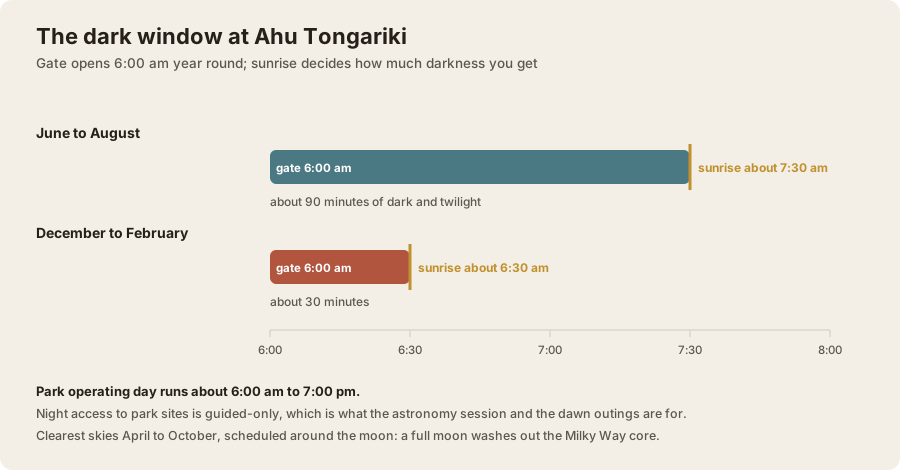
Not casually, and not by driving to a platform at midnight. Park sites close in the evening and require an accredited guide, which rules out unsupervised night access. The reliable option is the other end of the night: Ahu Tongariki opens at 6:00 AM for dawn visitors, and in the winter months sunrise does not arrive until around 7:30, leaving a real window of dark and twilight sky above the statues.
The protected-area framework behind those hours is set out on the national forestry service's park page. The dawn gap is the single most useful piece of astro-photography planning on the island, and almost nobody frames it this way. The dawn opening exists for sunrise photographers, but in June, July and August it hands you roughly an hour and a half before the sun clears the horizon, starting in genuine darkness and moving through astronomical and nautical twilight with fifteen moai in front of you.
| Season | Tongariki gate | Sunrise, approximately | Dark and twilight window before sunrise |
|---|---|---|---|
| June to August | Opens 6:00 AM | Around 7:30 AM | About 90 minutes |
| December to February | Opens 6:00 AM | Around 6:30 AM | About 30 minutes |
| Shoulder months | Opens 6:00 AM | Between the two bands above | Between 30 and 90 minutes |
Read that table next to the moon table and the plan writes itself. A winter morning at Tongariki, on a date near new moon, with the gate opening ninety minutes before sunrise, is the combination that produces the shot people think requires special permission. It requires a park ticket, an accredited guide and an alarm clock.
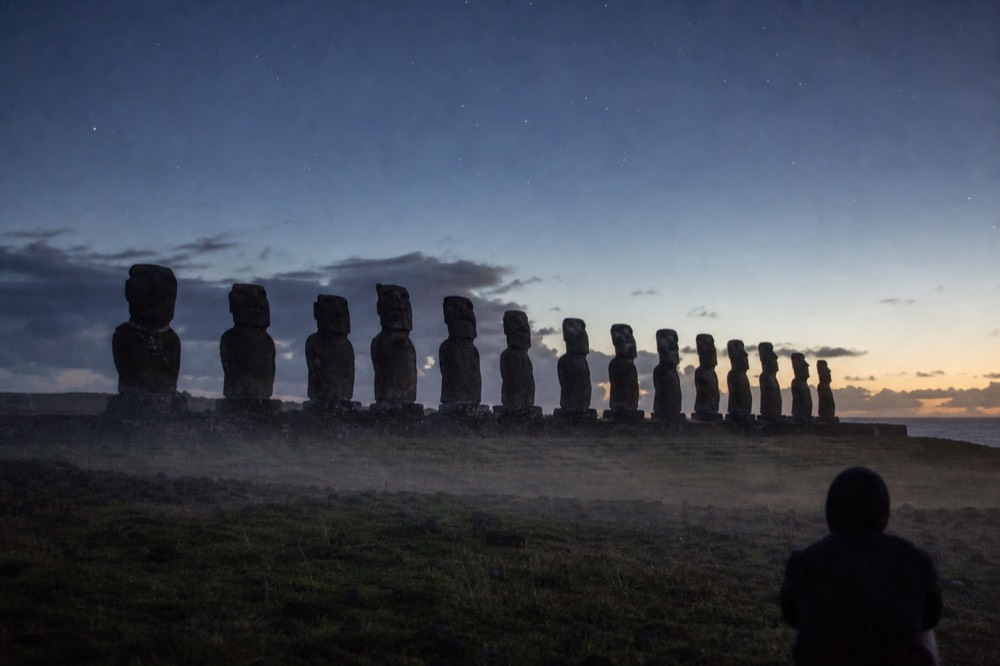
The rules that apply in daylight apply in the dark and get enforced. Statues must not be touched, leaned on or climbed, with fines running from 5 to 100 UTM under Chile's national monuments law, and drones need a permit. Tripod legs count as contact if you plant them where they should not go, so stay behind the ropes and off the platform stones. The reasoning behind that rule set is set out in why nobody is allowed to touch a moai, and the fragility of the volcanic tuff is not a technicality.
Dedicated sunrise departures exist precisely because the timing is awkward and the site is a drive from town. The verified astronomy session offers a separate night itinerary toward Anakena and Ahu Nau Nau; this is distinct from the Tongariki sunrise outing.
What should you wear and bring?
Layers, and less gear than you think. Night temperatures sit near the annual average of 20 to 21 degrees Celsius for much of the year and drop to around 15 to 17 in August, but constant trade winds make any exposed spot feel colder. A windproof outer layer, a red-light torch and shoes for uneven volcanic ground cover almost everything.
The wind is the variable people underestimate. Rapa Nui is a small landmass in open ocean with trade winds blowing more or less permanently, and standing still in the dark for three hours is a different proposition from walking a site in daylight. A fleece plus a shell beats one thick jacket, because you will want to shed a layer during the transfer and add it back the moment you stop moving.
| What to bring | Why | Note |
|---|---|---|
| Windproof outer layer | Constant trade winds, standing still for hours | The single most useful item on the list |
| Fleece or mid layer | August lows around 15 to 17C, roughly 59 to 63F | Easy to shed during transfers |
| Closed shoes with grip | Open volcanic ground, no lit paths | Sandals are a poor idea after dark |
| Red-light torch or a phone on red filter | White light destroys everyone's night vision, including yours | Guides will ask for this |
| Tripod, if photographing | Long exposures are the only way to record any of this | Never rest it on platform stones |
| Warm drink or a small flask | Useful for independent viewing | The Green Island session lists a hot drink and local cake; confirm dietary needs when booking |
| Insect repellent | Open grassland at night | Light use, not a serious issue |
| No binoculars needed | Telescopes are provided on a guided session | Bring them only if you already own a pair you like |
Camera advice is short and unglamorous: a wide lens, a tripod, and the acceptance that the Magellanic Clouds look better through your own dark-adapted eyes than through any screen you can carry. Phone night modes have improved enough to record the Milky Way band from here, which was not true a few years ago, and that is a direct consequence of how little light pollution there is to fight.
Is a guided night worth it when you could just walk outside?
Stepping outside is free and genuinely good, because the darkness is a property of the island rather than of the tour. What the session adds is telescopes, a guide who can find southern objects fast, transport past the last of the town glow, and the Polynesian navigation context that ties the sky to the statues. The naked-eye sky is yours either way.
That is an honest split, and it should be said plainly rather than sold around. Nobody needs to pay to see the Milky Way from Rapa Nui. Walk to the edge of Hanga Roa on a clear moonless night, wait twenty minutes for your eyes, and the band overhead will be the best most northern-hemisphere visitors have ever seen.
| Aspect | On your own from town | On the guided session |
|---|---|---|
| Darkness | Very good; town glow is small and easy to walk away from | Marginally better, out past the last of it |
| Naked-eye Milky Way and Magellanic Clouds | Fully available | Fully available, with someone pointing out structure |
| Telescope views of planets and clusters | Not available unless you carry your own | Included, and the main reason to book |
| Finding southern objects | Slow and frustrating on an unfamiliar sky | Immediate |
| Polynesian navigation and star lore | Not available | A core part of the session |
| Transport and safe footing after dark | Your problem, on unlit volcanic ground | Handled |
| Cost | Nothing | From $140, around 3.5 hours, rated 4.5 across 64 reviews |
| Weather risk | Try another suitable night | A full weather cancellation offers another date or refund; after the tour begins, any retry is subject to availability |
The case for booking comes down to which of those rows you care about. A traveller who owns binoculars, knows the sky and is happy sitting on a wall outside their guesthouse will get most of the value for free, and should spend the money on a private archaeology day instead. A traveller who has never seen the southern sky, wants it explained, and would like a telescope pointed at Saturn while somebody describes how these stars found this island will get their money's worth.
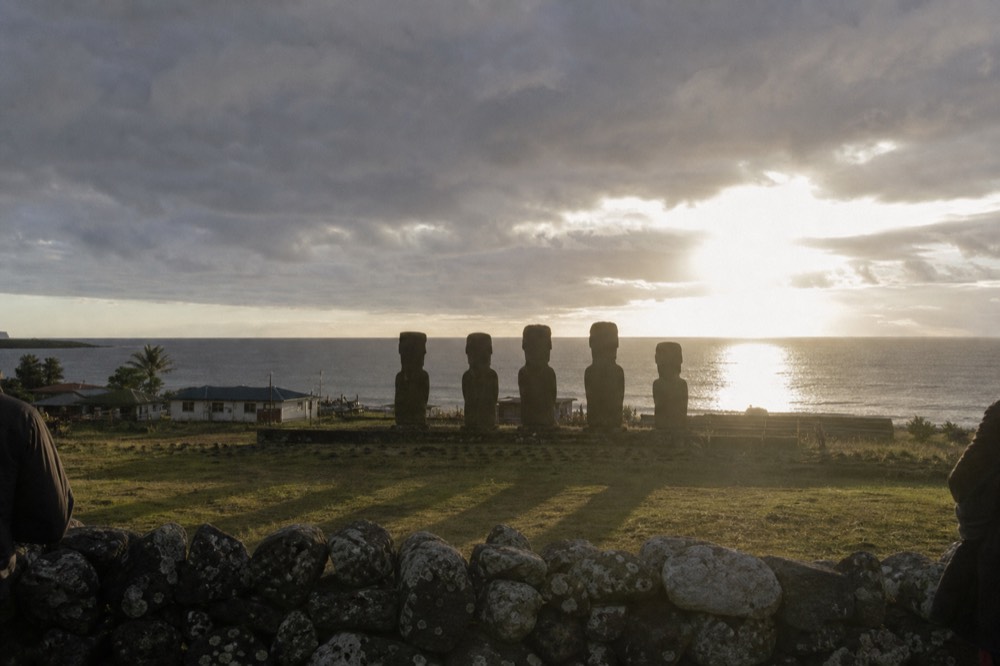
Where the session becomes clearly worth it is when it is paired properly. A day on the archaeological circuit followed by a night learning the wayfinding sky is a coherent island, not two activities, and the whole landscape is protected as one thing rather than as a list of monuments, as the World Heritage listing for Rapa Nui National Park makes clear. The day-by-day shape that fits both in puts the night session on an evening that is not followed by a 5:00 AM sunrise start, which is a scheduling mistake people make constantly. Every bookable tour on the island sits in one place if you want to build the week backwards from the clear nights.
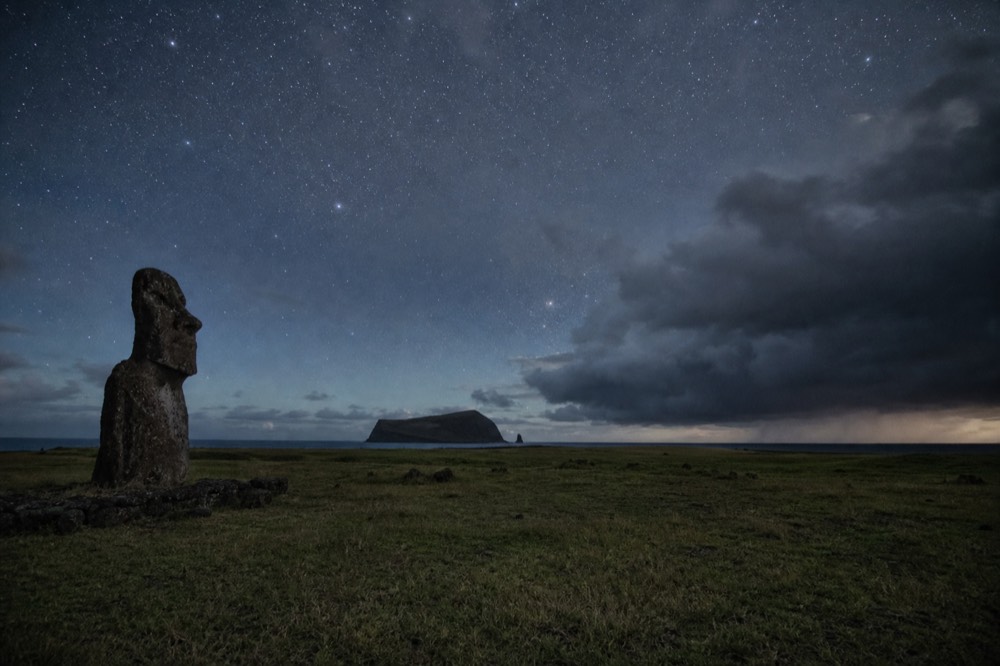
Common questions
Do you need a park ticket for a stargazing session?
Confirm the ticket requirement for your selected astronomy session with the operator. The Green Island itinerary includes a night stop near Anakena and Ahu Nau Nau; that does not establish general after-hours access to park sites. Daytime park visits have their own admission and guide requirements.
Can you see the Southern Cross from Easter Island all year?
Yes. It sits in the part of the sky that is permanently available from these latitudes, unlike from most of North America and Europe where it never rises. Its orientation changes through the night and through the year, which is one of the first things a guide will point out.
What happens if the session is cancelled for weather?
Green Island offers an alternative date or full refund if it cancels the whole session for weather. If conditions change after the tour starts, its terms exclude refunds and a further outing depends on availability. An early booking leaves more nights to work with.
Is there an observatory on Easter Island?
No permanent public observatory operates on the island in the way one does in the Atacama. Astronomy here is run as portable telescope sessions by local operators, which suits the conditions: the limiting factor is passing cloud rather than anything a fixed dome would solve.
Can you photograph the Milky Way with a phone here?
Modern phone night modes can record the galactic band from Rapa Nui, largely because there is almost no light pollution competing with it. A tripod or a stable surface helps considerably. For anything beyond the band itself, a camera with a wide lens and a proper long exposure is still a different class of result.
How far from Hanga Roa do you have to go for dark sky?
Not far. The town is small enough that a short drive or a ridge between you and it removes most of its glow, which is why sessions use a transfer of minutes rather than a serious expedition. The darkness is a property of the island's position in the Pacific, not of any particular spot on it.
Match The Day To Your Plans And Compare Costs
Editorial starting point. Confirm your party's age, access needs and departure details on the listing.
Compare Your Actual Quotes
Use totals for the same party and the same itinerary in one currency. Include guide, transport, admission and meals where relevant. These are your quotes, not live prices.
Match the same experience, dates and party. Compare guide and vehicle time, admission, meals and cancellation terms. A price difference alone does not establish equivalent value.